
What we reviewed and why
The State Budget sets out the SA Government’s fiscal strategy, actual and forecast financial position and new policy initiatives. It is also a key tool to manage and monitor government programs and performance. This report gives our insights into key trends and risks for the State’s public finances based on our review of the 2025-26 State Budget.
Our key insights
Health initiatives account for over half of total new expenditure initiatives in the four State Budgets from 2022-23 to 2025-26.
There is a heightened risk that SA Health will not achieve its expenditure forecasts. This is mainly due to hospital activity continuing to grow well above historical trends. SA Health has also had difficulties achieving its savings targets.
The SA Government will face challenges meeting employee expense forecasts as wage negotiations for almost three quarters of the general government sector workforce are occurring after a period of high inflation.
There are several risks attached to the SA Government’s historically large capital program, including delivering projects on time and on budget given construction industry capacity constraints and increasing costs. Small percentage budget overruns on the capital program could also significantly impact the State’s debt position.
Assessments of the sustainability of net operating surpluses should consider that Commonwealth grant revenue for capital projects is significant and one-off in nature.
Rising debt and interest costs owing to the scale of the State’s capital program may constrain the State’s fiscal capacity and its ability to deliver the same level of services.
Key budget indicators
South Australia is generally ‘middle of the pack’ on budget sustainability indicators compared to other states. It is in a less favourable position compared to Western Australia, is similar to New South Wales and Queensland, and in a more favourable position than Victoria.
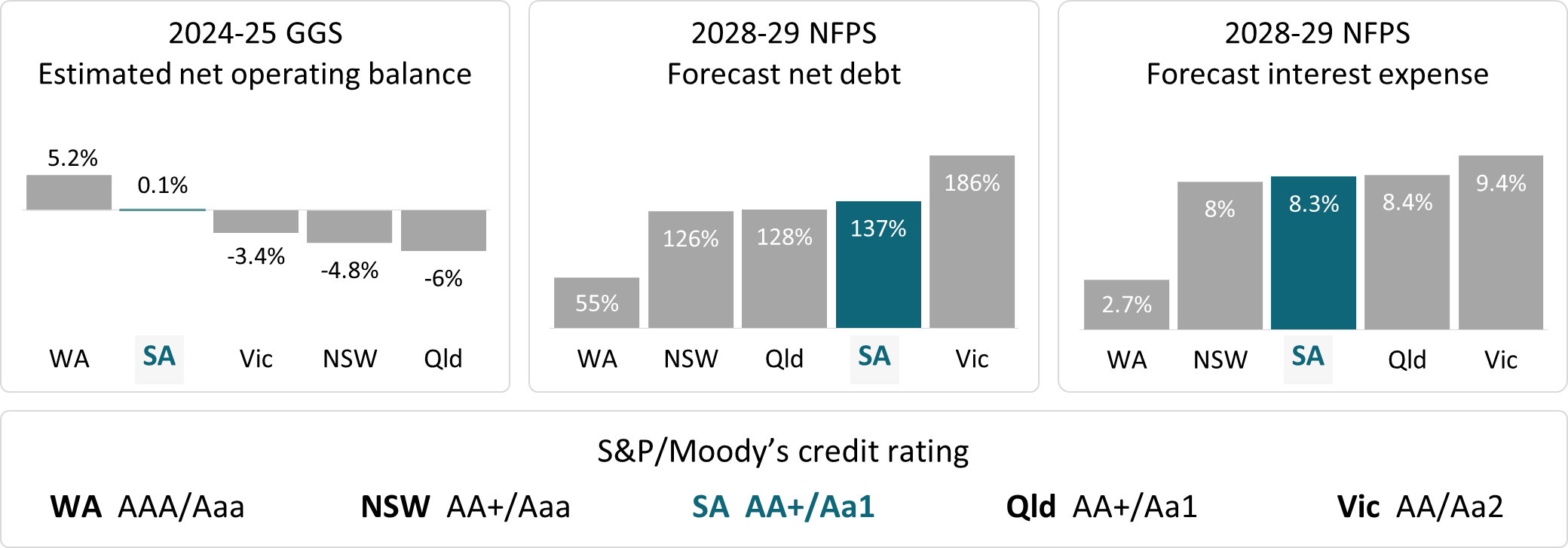
Note: GGS refers to the general government sector and NFPS to the non-financial public sector. The chart above does not include Tasmania as the 2025-26 Budget for this state was not available at the time this report was prepared.